A practical framework for comparing OEM and compatible toner programs by machine fit, validation evidence, total cost, change exposure, and support responsibility.
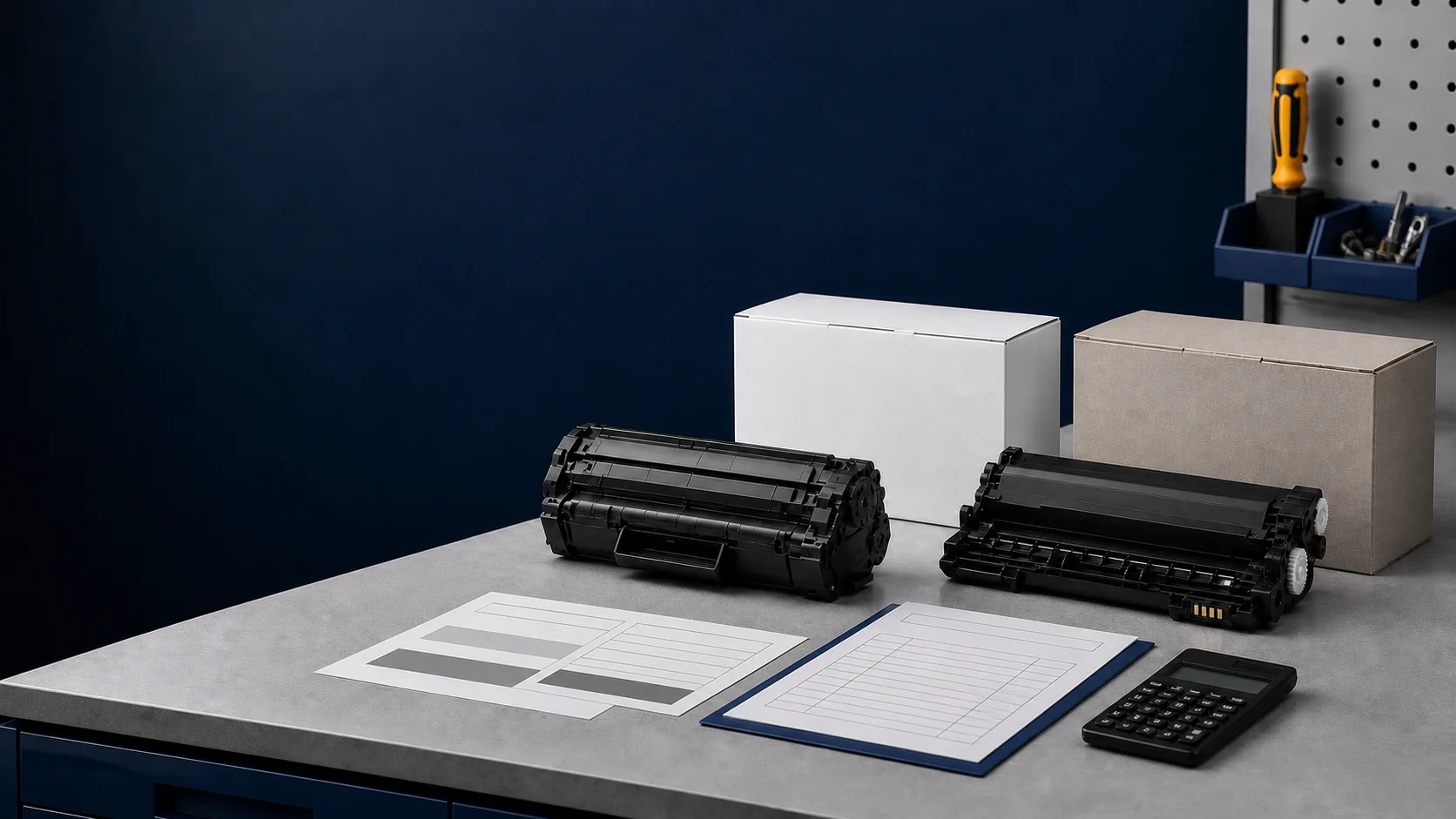
The short answer: neither category is automatically the right purchase.
OEM toner is usually the lowest-friction choice when a contract, device policy, critical application, or support arrangement requires the manufacturer's supply path.
A compatible program can reduce acquisition cost and support own-brand sourcing, but only when the buyer qualifies the exact cartridge, region, firmware context, print performance, change control, and claim process.
Compare two documented programs, not two labels.
What OEM and Compatible Mean
Procurement language is inconsistent, so define the construction and identity before comparing price or yield.
- OEM or original cartridge: marketed under the equipment manufacturer's brand for its equipment.
- Non-OEM new-build compatible cartridge: newly manufactured, independently branded, and intended for identified devices.
- Remanufactured cartridge: built from a previously used core that is inspected, cleaned, restored, refilled, and tested under the remanufacturer's process.
- Refilled cartridge: a used cartridge replenished with toner; the extent of component replacement and process control may vary.
- Private-label cartridge: a commercial branding arrangement, not a construction method; the product may be new-build or remanufactured.
In this guide, compatible means a lawful non-OEM new-build cartridge unless another construction is stated. It does not mean counterfeit, and the supplier should disclose construction, branding, origin, and destination-market conditions in writing.
OEM vs. Compatible Toner Cartridges at a Glance
| Decision factor | OEM toner cartridge | Independently compatible toner |
|---|---|---|
| Product identity | Equipment manufacturer's branded supply path. | Independent manufacturer or supply network; construction should be disclosed. |
| Up-front price | Often higher, but market and channel specific. | Often lower, but dependent on design, chip, packaging, and quantity. |
| Machine matching | Still requires the correct part number, model, suffix, and region. | Requires exact matching plus supplier validation of the current configuration. |
| Yield evidence | Declared yield still needs an applicable method and scope. | Compare the same method, device class, and stated conditions. |
| Firmware and change exposure | Managed within the OEM ecosystem, although region, subscription, and model still matter. | Chip revision and firmware change control are material approval items. |
| Support and claims | Manufacturer, authorized channel, warranty, and service terms apply. | Supplier claim process and the dealer or service provider's workflow must be defined. |
| Private-label option | Normally not controlled by an independent buyer. | May be available, subject to product, order, artwork, market, and compliance review. |
| Buyer workload | Lower initial product-qualification burden. | Higher initial and ongoing qualification and change-control burden. |
Compatible is not a quality grade. Two offers for the same OEM reference can differ in toner formulation, component design, yield target, chip revision, sealing, assembly, packaging, and inspection. Compare specifications and evidence, not category names.
How to Compare Print Performance and Yield Evidence
Test the exact products on representative devices with the same firmware, paper, print settings, environment, and repeatable test file. Use an OEM reference print where useful, but define acceptance limits instead of asking whether two pages simply look the same.
- Text sharpness and small reversed text.
- Solid density, uniformity, and background cleanliness.
- Grayscale or color balance where the application requires it.
- Banding, streaks, repeating marks, contamination, and ghosting.
- Toner adhesion on representative paper.
- Start-of-life, mid-life, and end-of-life behavior.
- Storage and transport performance where relevant.
For eligible office devices, ISO/IEC 19752:2025 covers monochrome toner-cartridge yield and ISO/IEC 19798:2025 covers color toner-cartridge yield. Both standards measure yield under defined conditions; they do not establish print quality, reliability, or total cost per page. Their scope excludes some A3, production, photo-dedicated, and large-format systems, so a supplier should state the exact method and device class rather than use the phrase ISO quality. Real-world output also changes with page coverage, job size, settings, environment, power cycles, and user behavior.
Build a Total Program Cost
Acquisition price is only one line in the decision. Use the same time period, devices, denominator, and claim rules for both programs.
| Cost block | Evidence to collect | Common comparison error |
|---|---|---|
| Product and landed logistics | Quoted price, freight, duty, packaging, and emergency shipment cost. | Comparing cartridge price alone. |
| Validated usable output | Applicable yield basis, accepted pages, and replacement events. | Treating declared yield as guaranteed output. |
| Service burden | Installations, calls, cleaning, returns, replacements, and labor. | Assuming every failure is zero-cost or fully credited. |
| Inventory and change | Safety stock, obsolete revisions, replenishment timing, and urgent freight. | Ignoring firmware or chip revisions that strand inventory. |
| Claims and downtime | Evidence collection, credits, customer handling, and device unavailability. | Using an unverified generic savings percentage. |
A credible comparison replaces assumptions with traceable data from the actual pilot and claim workflow. Without those data, a percentage-savings headline is speculation.
Control Compatibility, Firmware, and Legal Risk
A model family name is not enough to approve a cartridge. Lock the configuration fields below before a sample or purchase order is released.
- Exact OEM cartridge reference and capacity version.
- Complete printer or copier model, including suffix.
- Destination market and regional cartridge configuration.
- Current firmware, subscription, or recognition context where relevant.
- Chip or contact interface and approved revision.
- Toner formulation and machine-generation match.
- Cartridge geometry, keys, seals, gears, contacts, and shutters.
- Packaging suitable for the actual freight route.
If the device uses separate toner and drum consumables, confirm which component the reference number identifies; see HBtoner's guide to drum-unit architecture.
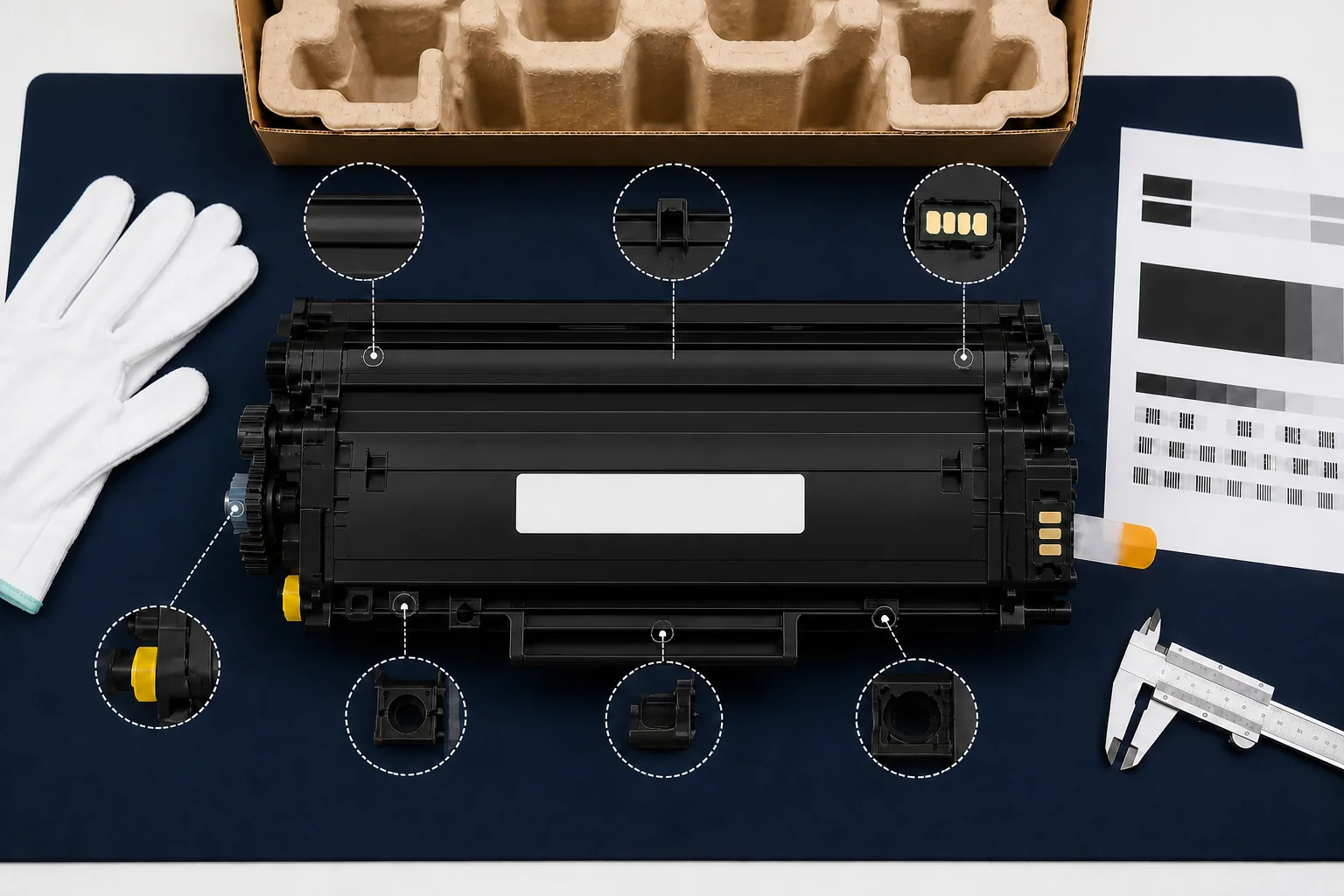
Firmware policy is not uniform. HP states that some printers use dynamic security and may reject cartridges that do not use an HP chip or electronic circuitry, while Brother states in a current support notice that its firmware updates do not block third-party toner or cartridges covered by that notice. Treat recognition as model-, region-, firmware-, and date-specific, and do not advise users to defeat access controls.
Do not repeat the blanket claim that third-party toner automatically voids an entire printer warranty. In the U.S. consumer-warranty context, the Federal Trade Commission explains that tie-in restrictions are generally not allowed unless the specified item or service is provided free or a waiver applies; a warrantor may still exclude damage caused by unauthorized parts or service. That rule does not settle business leases, managed-print agreements, service contracts, or other markets, so review the applicable documents before changing supply.
Intellectual-property and labeling risk is also product- and market-specific. Ask for a documented review of patents, trademarks, packaging, origin claims, safety information, and destination rules rather than accepting a universal patent-safe promise.
When to Choose OEM or Compatible
When OEM Is the Better Fit
- A customer contract or regulated procedure specifies OEM consumables.
- The device, subscription, lease, or service arrangement requires the manufacturer's supply path.
- The application is unusually color-critical or downtime-sensitive and no alternative is qualified.
- Volume is too low to support a meaningful compatible validation program.
- The exact regional configuration or current chip revision is unavailable.
- The organization prefers one manufacturer-led support channel.
When Compatible Supply Can Make Sense
- The buyer has representative devices and a repeatable approval plan.
- Acquisition cost or own-brand strategy matters, but the decision is still made on total program cost.
- The supplier discloses construction, test basis, lot identity, and current configuration.
- A pilot confirms fit, recognition, print performance, and usable output on the target fleet.
- Claim ownership, replacement logistics, packaging, and change notification are documented.
Do not extrapolate one approved cartridge to another SKU, market, or firmware revision. Each material change should trigger a defined review or requalification decision.
Questions to Ask Before Approving a Toner Supplier
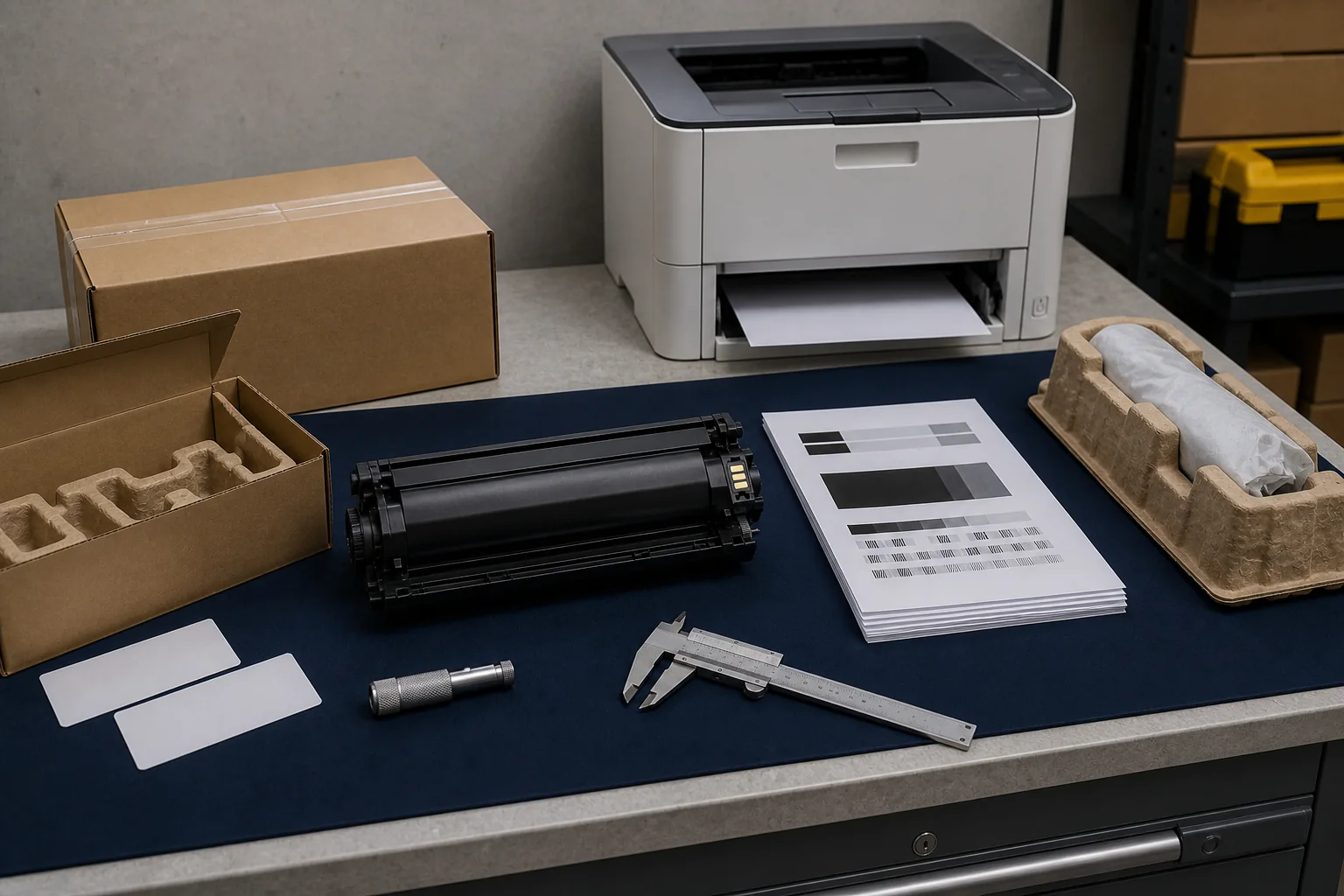
- Specify the exact OEM reference, device, market, firmware context, construction, and packaging requirement.
- Review the yield method, print-quality plan, lot traceability, change control, claims, legal assurances, and relevant compliance documents.
- Approve samples on representative devices using a written acceptance plan.
- Run a pilot that observes early-, mid-, and late-life behavior and records every replacement or intervention.
- Check protective packaging and transit suitability for the actual shipping route.
- Release only the approved configuration, retain evidence, and monitor field reports for changes.
- Which exact OEM references, regional machines, and firmware versions were used for validation?
- Is the product new-build or remanufactured, and which components are controlled?
- What is the yield statement, standard version, device class, and test basis?
- What print defects, dimensions, recognition checks, and sample sizes are in the acceptance plan?
- How are chip, design, material, and packaging revisions identified and communicated?
- Can lot codes trace complaints to production and material records?
- What evidence is required for a claim, who pays freight, and what damage is covered?
- How are trademarks, patents, safety information, and destination-market rules reviewed?
Frequently Asked Questions
Will compatible toner damage a printer?
The category alone cannot answer that question. An incorrect or poorly controlled cartridge can cause fit, recognition, leakage, print-quality, or machine issues; a properly matched product still needs qualification and a defined claim process.
Is compatible toner the same as counterfeit toner?
No. A legitimate compatible product is independently branded and accurately described, while a counterfeit misrepresents its identity, origin, or authorization.
Are remanufactured and compatible cartridges identical?
Not necessarily. Remanufactured cartridges use previously used cores, while compatible often refers to non-OEM new-build products; require a written construction description because sellers use the terms differently.
Which option has better yield?
A category label does not determine yield. Compare the exact products under the same applicable method and conditions, then validate output in the real application.
Can compatible cartridges be private labeled?
They may be, depending on the product, order, artwork, market, and compliance review. Define the product construction, responsible supplier, supported claims, and final label approval before ordering.
Does using compatible toner void the printer warranty?
Do not assume a universal answer. U.S. consumer-warranty rules do not support a blanket automatic-void statement, but damage attributable to third-party supplies may be excluded; business contracts, leases, service plans, and other markets require their own review.
Choose the Program, Not Just the Cartridge
The right choice is the program that meets documented application, risk, support, and total-cost requirements. For a configuration review and quotation discussion, send HBtoner the OEM reference, complete device model and suffix, destination market, quantity and replenishment timing, clear label and all-side photographs, current message or firmware context, and any neutral-label or private-label requirement. HBtoner can coordinate the appropriate source and specification through its supply network once the configuration is clear; compatibility is confirmed only against the agreed product and market specification.
Compatibility and Independence Notice
Brand and product names are used only to identify compatibility. HBtoner is an independent supplier and is not affiliated with or endorsed by the original equipment manufacturers mentioned. Procedures, warranty terms, firmware behavior, and legal requirements vary by model and market; consult the exact manufacturer's documentation and applicable agreements.
Selected Official Sources
- U.S. General Services Administration toner category definitions - Supports the distinction among new OEM, non-OEM new-build, remanufactured, refilled, gray-market, and counterfeit products.
- ISO/IEC 19752:2025 - Current monochrome toner-cartridge yield standard and scope limitations.
- ISO/IEC 19798:2025 - Current color toner-cartridge yield standard and scope limitations.
- FTC Businessperson's Guide to Federal Warranty Law - U.S. consumer-warranty tie-in and damage-exclusion context.
- HP dynamic security guidance - An official example of model-specific cartridge recognition and firmware behavior.
- Brother firmware and third-party supplies notice - An official example showing that manufacturer firmware positions are not uniform.