Compare factories and trading companies, verify sample evidence, and use a supplier scorecard to source compatible copier toner in China.
Choose a copier toner supplier in China by checking how your exact products are specified, tested, traced and supported. A factory, trading company or coordinator can suit the job; the better fit depends on your product range, order volumes and ability to manage multiple sources. For importers, wholesalers and service providers, a useful decision combines documented controls, a representative sample trial and comparable total costs.
Cover image: Representative supplier-review setting; the bottles and workspace are not verified HBtoner products or facilities.
Compare the operating models
“Factory direct” does not tell you which operations happen at the quoted site. A supplier may mold bottles, assemble cartridges, formulate toner or buy some components from outside sources. Ask which processes are in house, which are outsourced and who approves the finished product.
On narrow screens, swipe horizontally to compare all columns.
| Supply model | Potential fit | Evidence to request |
|---|---|---|
| Specialized factory | Focused product range with repeated orders and direct engineering needs | Actual site processes, technical contact and outsourced component controls |
| Trading company | Mixed sourcing where purchasing and communication support add value | Approved sources, inspection responsibility and ownership of claims |
| Multi-factory coordinator | Broader portfolios needing specification control and shipment consolidation | A controlled source for each product, traceability and change approval |
These are possible strengths, not guarantees of price or quality. HBtoner coordinates the appropriate source and specification through a manufacturing network for the product and destination. Ask for the same product-level evidence whichever business model you consider.
Write one sourcing brief before comparing quotes
- Identify each OEM reference, full copier model and suffix, destination market, color and proposed construction, including new-build or remanufactured where relevant.
- Provide quantities by item, reorder timing, label and carton needs, and firmware or chip information where relevant.
- Agree the sample test conditions, acceptance criteria, required documents and shipping basis before treating prices as comparable.
Review the OEM versus compatible toner guide when defining product construction and expectations.
Select your destination country and send this brief to HBtoner for a configuration review and quotation discussion.
Follow one product through the evidence
Request a redacted example connecting a quotation to an approved specification, manufacturing source, inspection record and shipment lot. A lot code has limited value if the team cannot retrieve the corresponding records. Ask the supplier to explain a past nonconformity using anonymized records: what was contained, what changed and how the correction was checked.
For a certificate, check the exact legal holder, site, scope, certificate number, issuer and current status. ISO develops standards but does not issue certification itself. ISO 9001 concerns a quality management system; it does not by itself prove that a particular toner meets your compatibility or print requirements. Where an accredited certificate is claimed, use the issuer and relevant accreditation or verification service to check it rather than relying on a logo.
Keep destination requirements as a separate approval task covering the quoted product and its labels and documents. Do not treat a general assurance such as “compliant everywhere” as evidence.
Approve samples against written criteria
Agree the trial before samples arrive so both parties know what a pass means. Record the sample quantity, machine models, firmware, device condition, paper, print settings, test files and acceptance thresholds. Choose thresholds for your application; this guide does not supply a universal defect allowance or sample size.
- Before installation, compare the reference, lot, packaging, seals and visible condition with the approved specification.
- During the trial, document fit, recognition and print results, including density, background, color where applicable and recurring defects.
- Retain representative print samples and record results beyond the first pages, including later-stage behavior where practical.
- Release a controlled pilot lot only after documenting the result, then track field feedback by lot before expanding orders.
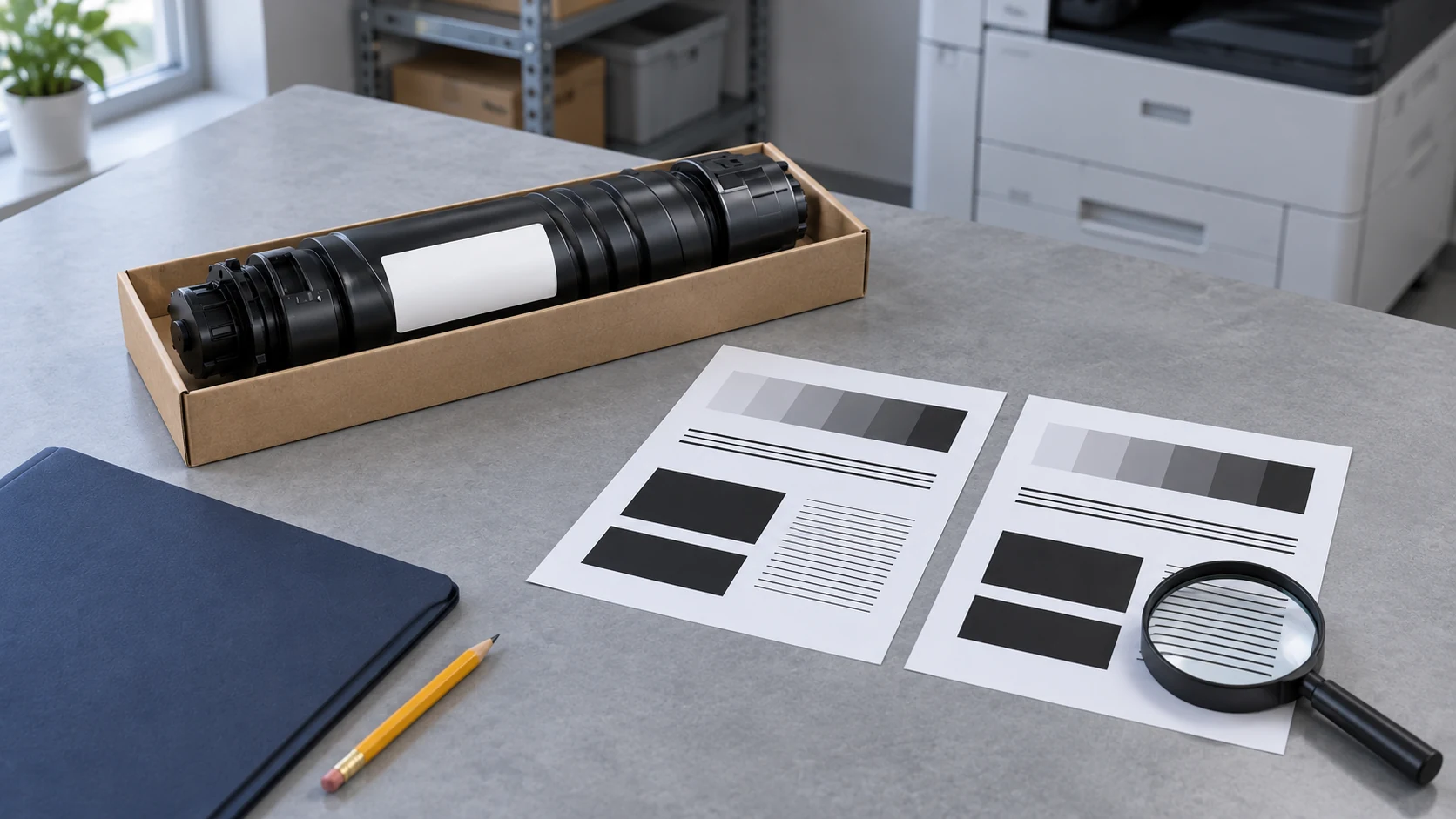
If a supplier quotes page yield, request the named method and edition, test report, applicable device and stated conditions. ISO/IEC 19752:2025 addresses toner-cartridge yield for monochrome electrophotographic printers and multifunction devices containing printer components. A yield result does not establish print quality, reliability or universal compatibility, and actual page counts depend on the work printed.
Use the drum unit guide to separate toner evaluation from other imaging components.
Compare landed cost and operating cost separately
Normalize the quoted configuration, quantity, currency, packaging, named delivery place and shipping terms. ICC Incoterms® 2020 rules allocate relevant delivery responsibilities, costs and risks between buyer and seller; record the chosen rule and named place in the contract. Then build your own cost model, avoiding items already included in the quote.
- Landed purchase cost: goods, separately charged packaging, freight, insurance, customs handling, duties and nonrecoverable taxes as applicable.
- Operating exposure: inspection, financing and stockholding, service labor, returns, replacement freight, downtime and supplier coordination.
Use measured figures where available and label estimates with their assumptions. Keep potential savings separate from proven savings until the pilot provides evidence.
Use an editable evidence scorecard
The weights below are an illustrative buyer template totaling 100%, not measured supplier performance or an industry benchmark. Adjust them before reviewing bids and complete one copy for each candidate.
On narrow screens, swipe horizontally to compare all columns.
| Criterion | Example weight | Evidence for assessment | Score 0–5 |
|---|---|---|---|
| Compatibility control | 25% | Approved model and reference matrix; sample results | To assess |
| Quality and changes | 25% | Control plan, release records and change approval | To assess |
| Traceability and support | 15% | Retrievable lot records and claim workflow | To assess |
| Supply planning | 15% | Capacity basis, schedule and continuity plan | To assess |
| Packaging and documents | 10% | Approved artwork and relevant destination documents | To assess |
| Commercial fit | 10% | Comparable cost model and written terms | To assess |
Use 0 for no usable evidence, 3 for adequate documented evidence and 5 for strong evidence validated in your review; define intermediate scores consistently. For a total out of 100, multiply each score divided by 5 by its weight in percentage points, then add the results. Keep mandatory approval gates separate: unresolved product identity, falsified documents or unapproved substitutions should stop release regardless of the total.
Control repeat orders and claims
The purchase specification should identify the approved source, product revision, chip where applicable, packaging version and retained sample reference. Agree which changes require notification, written approval or new testing, including changes to toner, chips, seals or manufacturing source. Define the claim owner, acknowledgement timing, investigation evidence and remedy process in writing rather than assuming a standard warranty. A useful claim record includes the item and lot, complete machine model, firmware where relevant, installation history, error messages and print samples.
At receipt, compare carton and item identification, quantities and packaging revision with the purchase order, then retrieve a lot record as a practical traceability check. Keep disputed goods identifiable and separate while the supplier investigates, recording the reason for the hold and who can authorize release. For claimed failure rates, request the affected quantity, supplied quantity, reporting period, defect definition and exclusions before comparing suppliers. A replacement policy alone does not show why a defect happened or whether a repeat shipment will avoid it.
Keep waste toner containers on their own specification line using the waste toner box guide.
Frequently asked questions
Is buying directly from a factory always cheaper?
No; compare the same configuration and delivery basis, then include inspection, inventory, service and coordination costs.
Can a trading company control product quality?
It can if it controls specifications, approved sources, inspection, traceability and changes, with clear responsibility for claims.
Should samples be free?
Sample pricing is a commercial term to confirm for the item; a traceable sample representing the proposed production specification matters more than whether it is free.
What MOQ and lead time should I expect?
Request written terms by item, quantity and packaging, including when the lead-time clock starts and which approvals or material dependencies affect it.
Does one good sample justify a large order?
A passing sample supports the evaluated configuration; use a controlled pilot and lot monitoring to check whether repeat supply meets the same requirements.
Prepare your HBtoner sourcing inquiry
Send the destination country, OEM references, complete machine models and suffixes, quantities, reorder plan, label photos and packaging needs. Add chip or firmware details where relevant and identify the sample checks your team needs before approval. HBtoner can use this information to review the proposed configuration and discuss an item-specific quotation.
Send a sourcing inquiry to HBtoner.
OEM and product references are used only for identification and compatibility; HBtoner is independent of, and not affiliated with or endorsed by, the original equipment manufacturers.